The decks of Briscola
Every corner of Italy has its own playing cards, and anyone who grew up with one pack can spot the others at a glance. Here is where the nine decks in the game come from, and what sets each one apart.
Why Italy has so many decks
Playing cards reached Italy in the second half of the fourteenth century, from Mamluk Egypt. Mamluk packs already had cups, coins, swords and polo sticks. Nobody in Italy played polo, so the sticks became plain batons, or clubs.
For centuries Italy was a patchwork of separate states. Each area went its own way, and the designs settled into regional patterns that are still printed today. Any of them will do for Briscola: the rules and the points never change.
Italian, Spanish and French suits
Cups, coins, swords and clubs are known as the Latin suits, and in Italy they are drawn in two ways.
- Italian style, in the north-east: swords curved like scimitars, clubs straight like sceptres, tall cups that are sometimes six-sided. Swords and clubs cross over each other.
- Spanish style, in the centre, the south, the islands and Piacenza: straight swords, knobbly clubs like cudgels, smaller rounded cups.
In the north-west and in Tuscany, the regional decks use French suits instead: hearts, diamonds, clubs and spades. In Tuscany diamonds are often called mattoni, “bricks”.
Forty cards: how a deck is built
The most common Italian deck has forty cards: ace to seven, plus three court cards in each suit. With Latin suits the court cards are the jack (fante), the knight (cavallo) and the king (re). There are no eights, nines or tens, and that is no accident: in the sixteenth and seventeenth centuries the fashionable games, such as primiera and ombre, used a shortened pack, and the format stuck.
French-suited decks have a jack, queen and king. For Briscola you remove the eights, nines and tens, and the queen takes the knight’s place: she is worth three points and ranks between the jack and the king.
Why the ace of coins looks odd
In many regional decks the ace of coins has a large empty circle, or very little artwork at all. The reason is a tax. Until 1972 every pack sold in Italy had to carry a stamp proving the duty had been paid, and it usually went on the ace of coins. The tax has gone, but the circle stayed in the design.
Neapolitan cards (Napoletane)
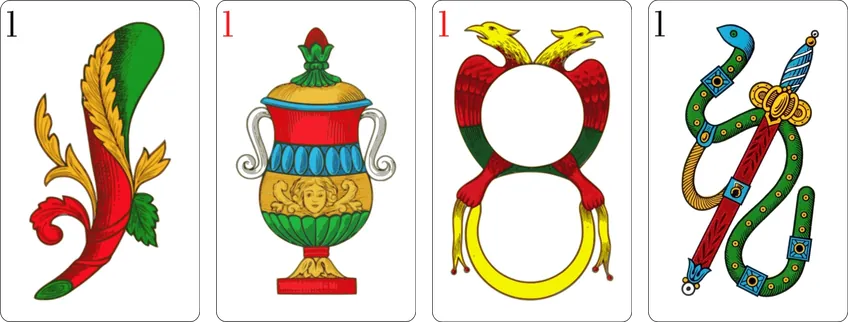
These are among the most widely used regional cards in Italy, found across most of the south apart from Sicily and Sardinia. They have Spanish-style suits and full-length court figures. The design goes back to the sixteenth century, as the moustaches and hairstyles of the figures show.
A few cards are instantly recognisable. The three of clubs has a moustachioed grotesque mask in the middle, known as the Gatto Mammone. The ace of coins is a double-headed eagle. The knight of swords is a Moorish rider with a turban and a scimitar.
Piacentine
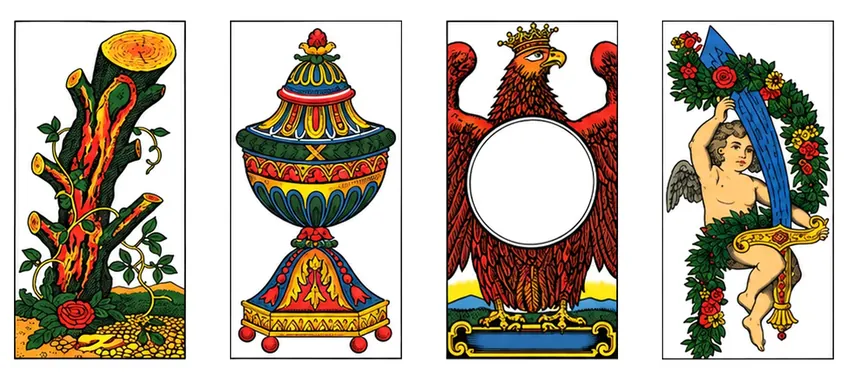
The northernmost Spanish-suited cards in Italy. Born in Piacenza, they are used across much of Emilia, south-eastern Lombardy, the Apennine valleys of Garfagnana and Lunigiana, the Marche, Umbria and Lazio. The usual account is that Spanish suits reached Piacenza with French soldiers at the end of the eighteenth century.
They are long, narrow cards. Until the middle of the twentieth century the court cards were full-length; since then they have nearly always been double-headed, split across the middle. The ace of coins is a large crowned eagle, and the ace of swords is held up by a cherub that locals call l’Angiolino, “the little angel”. All the court figures stand.
Antique Piacentine
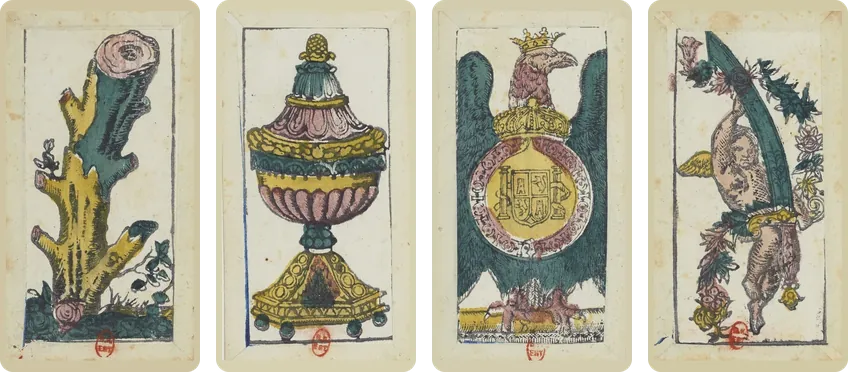
This is a Piacentine pack printed in Piacenza around 1800 and now held by the National Library of France. The cards are woodcuts, hand-coloured through stencils, one colour at a time. You can see the maker’s hand: the colour does not always stay inside the lines.
The court figures are full-length and single-headed, as Piacentine cards were until the middle of the twentieth century. The king of cups still carries the tax stamp of the day. Playing with them is like sitting down at a table two hundred years ago.
Bergamasche
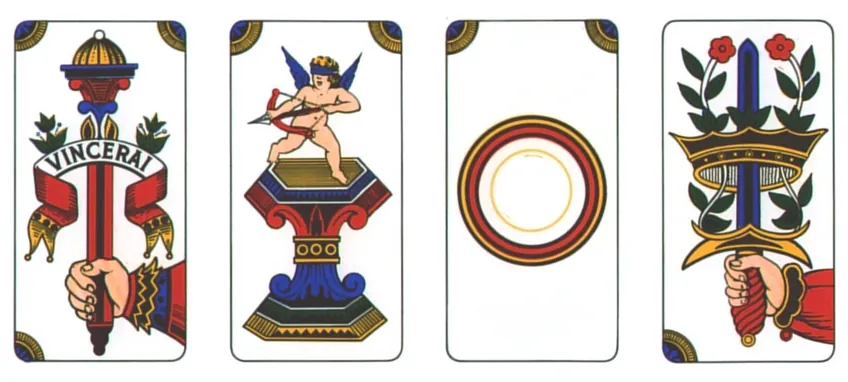
From the province of Bergamo, with Italian-style suits. The pack has forty cards, and the court figures are double-headed, split horizontally.
The ace of clubs carries a scroll with the motto “Vincerai”, “you will win”. The ace of cups is shaped like a fountain, a motif shared with the Trentine and Bresciane. The three patterns are close relatives: they took shape in neighbouring areas and look very alike.
Bresciane
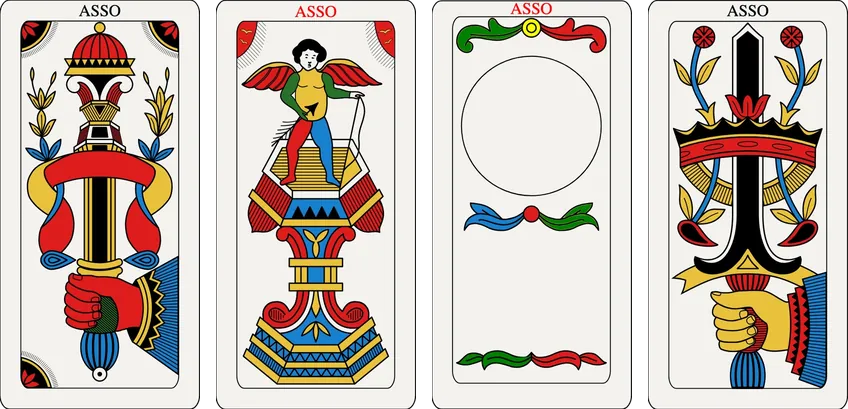
The cards of the province of Brescia, with Italian-style suits. In the shops they only come in packs of fifty-two, because they are also used for cicera bigia, a local game; for Briscola you take out the eights, nines and tens, and in the game you already get the forty-card pack.
The court figures are full-length, in flat colours with naive proportions. These are the smallest regional cards in Italy, and many of them have nicknames: the four of swords, for example, is the Madonnina dei prati, “the little Madonna of the meadows”.
Trentine
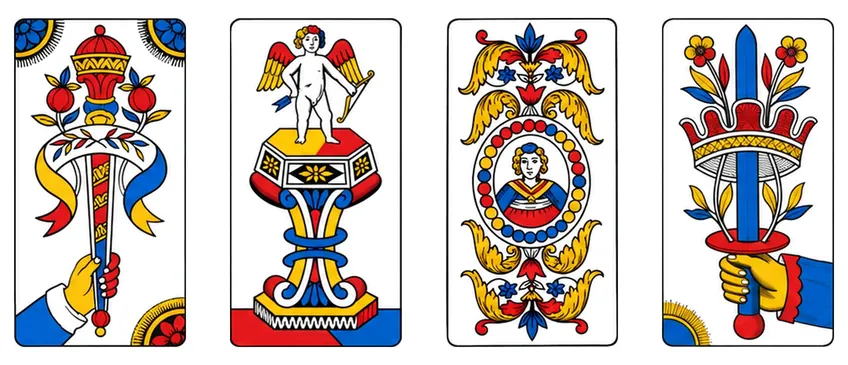
From the province of Trento, with Italian-style suits. They are thought to be the oldest Italian pattern still in use, and the ancestor of the Bergamasche and Bresciane.
The giveaway is the four kings, every one of them seated on a throne. The court figures are full-length and archaic, drawn in a handful of flat colours with no shading: white, black, red, blue and yellow. The cards from two to seven carry their number.
Spanish cards
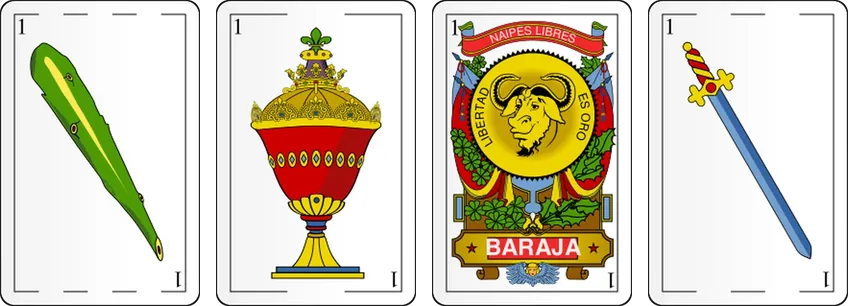
The Spanish deck, the baraja española, has the same suits as Italian cards under Spanish names: oros, copas, espadas and bastos. The swords are straight and the clubs are knobbly cudgels. A full Spanish pack has forty-eight cards, one to nine plus three court cards: the sota, the caballo and the rey, numbered 10, 11 and 12. The forty-card version drops the eights and nines, and that is the one used for Briscola.
In traditional Spanish packs the frame line around each card has small gaps that tell you the suit even when the cards are fanned: one for cups, two for swords, three for clubs and none for coins.
Spanish Fantasy
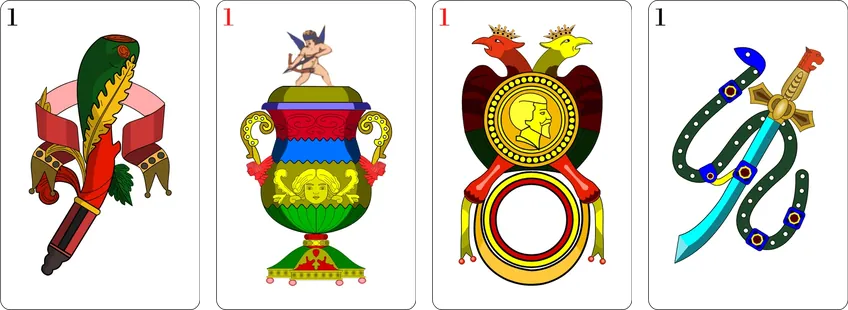
A modern Spanish-suited deck, drawn in bold flat colours with court figures in fanciful costume. The rules are exactly the same: the sota counts as the jack and the caballo as the knight. It is the pack for anyone who likes Spanish cards but wants something more cheerful on the table.
French-suited cards with large indices
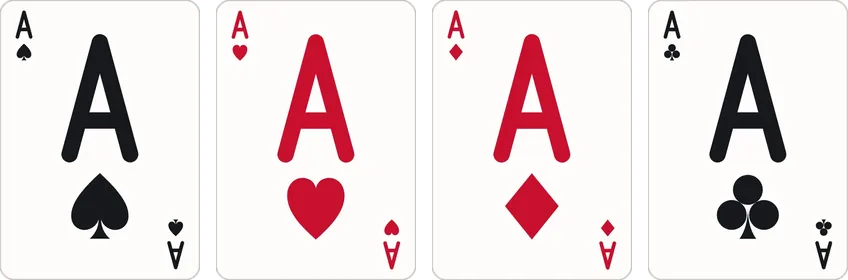
Briscola is also played in Italy with French suits. This deck has forty cards, ace to seven plus jack, queen and king, with very large indices in the corners. They stay easy to read on the smallest screen, so it is the most comfortable choice if you want to take in your hand at a glance.
The queen counts as the knight, three points, and ranks between the jack and the king. Everything else works just as it does with Italian cards.
How to choose your deck in the game
On the game’s front screen there is a showcase with all nine decks. The one in the middle fans out into three cards, an ace, a court card and a three, which is enough to see how it is drawn.
Turn through them with the arrows, by dragging, or by tapping a deck at the side. Look at each one up close, and stop on the one you grew up with: that is the deck you will play with. The rules screen, too, shows the scoring cards drawn in the deck you picked.